Extra Virgin Olive Oil- Is it worth buying with the ever-increasing price?
What Makes EVOO Special?
I don’t know about you, but I’ve been cooking with Extra Virgin Olive Oil (EVOO) for as long as I can remember. It tastes great, it’s incredibly versatile in the kitchen, and for years it offered good value on top of its well‑known health benefits. Those benefits come from its balanced fatty acid profile—particularly its high oleic acid content and the healthy ratio of omega‑3 to omega‑6—plus vitamin E and a range of natural phenolic compounds, often called “polyphenols”. But with the ever increasing price, you might be wondering whether it’s time to switch to another culinary oil—and whether there’s truly a like‑for‑like alternative?
Understanding Olive Oil Categories
Let’s clear up the distinction between some of the types of Olive Oil you may encounter as there are six categories classified by the International Olive Council. The first category ‘Virgin Olive Oils’ includes oils pressed of pure olive juice, EVOO is considered the highest quality characterised for low acidity of no more than 0.8g per 100g; followed by Virgin Olive Oil (VOO) to Lampante olive oil (not fit for consumption and historically used to fuel lamps) which has an acidity greater than 3.3g per 100g. The next five categories cascade from ‘Refined Olive Oil’ to blended oils termed ‘Olive Oil’, to oils that involve greater processing with solvents concluding with ‘Pomace oil’.
You could say EVOO is the champagne of Olive oil, and similar to champagne its location gives an initial indication of its potential quality due to a protected status under EU law by its Geographical Indications (GIs) and Protected Designation of Origin (PDO).
Production and Quality Factors
Olives are harvested from October to December, with the first press producing EVOO. The quality of EVOO is also influenced by its terroir – soil, climate, topography, biodiversity and the skill of producers. These processes will influence the presence and concentration of health-promoting compounds, specifically polyphenols, in EVOO. However, these compounds are notoriously fragile, and post purchase can degrade quickly from heat, sunlight, and oxygen. The packaging can reflect its quality; for example, clear plastic containers may be affected by ultraviolet exposure. Storing EVOO near a stove increases the risk of elevated temperatures, while unsealed containers allow oxygen to compromise the oil's integrity.
Polyphenol Content and Health Benefits
Over 30 phenolic compounds have been found in EVOO, though not all oils contain every compound. The types and levels of polyphenols vary widely (0.02–600 mg/kg) depending on factors like variety and region. They give the oil a bitter, pungent taste and strong fruity flavour, showing high sensory quality. Polyphenols are a group of compounds present in plants that help shield them from environmental stress and attacks by pathogens. Studies have shown that these compounds have a benefit to human health by reducing inflammation (antioxidant) resulting in cell damage. Diets rich in polyphenols are reported to protect against some cancers, cardiovascular diseases, type 2 diabetes, osteoporosis, pancreatitis, gastrointestinal problems, lung damage, and neurodegenerative diseases.
The health claim for EVOO is protected in EU legislation from its polyphenol content, that must contain at least “5 mg of hydroxytyrosol and its derivatives (e.g. oleuropein complex and tyrosol) per 20 g of olive oil”; that corresponds to a minimum total polyphenol content of 250mg/kg. The disclaimer “a daily intake of 20g of such an olive oil provides the expected beneficial effects” must be added to the label.
Variability and Shelf Life
You may well ask how this is enforced or controlled as studies report a vast variability in concentration of polyphenols in EVOO globally. Also, think about when you bought your bottle of EVOO—how old is it or how long it has been bottled. It is suggested that EVOO has a shelf life of approximately 12 months, with up to a 43% reduction in polyphenol content during typical storage conditions. A study of 100 EVOO samples showed that only four had a total polyphenol content above 250mg/kg and only three oils having a hydroxytyrosol content higher than 1.5mg – much less than the 5mg required by the EU health claim regulation.
This begs the question is your store bought EVOO up to its haloed stature? Typically, supermarkets’ own-label and mass-produced branded EVOOs are typically composed of blends sourced through the international markets. As a result, these oils originate from various regions and often differ in quality and flavour; blended to achieve a specific style and price point as required by the buyers. These oils are fine but, in my opinion, they benefit the health haloed status through a marketing sleight of hand of association rather than meeting nor matching the minimum total polyphenol of other EVOOs.
Labels like "cold pressed" or "first pressed" on virgin and extra virgin olive oil are mostly marketing terms, since most olive oil today is made with centrifuges, not presses. Furthermore, I found some instances in studies of EVOOs didn’t distinguish between grades of olive oils which is a common reported limitation to be considered.
Premium EVOO and Accessibility
You’ll find smaller niche EVOO producers state the total polyphenol content of their produce and in many cases obtain third-party testing to enhance transparency and credibility. There are associated costs to this which elevate the price of the end product, which I feel may place it out of reach for many people striving for those health benefitting compounds.
Fatty-Acid Profile
Putting the ‘polyphenol’ benefits of EVOO to one side it’s important to consider the fatty acid profile i.e. its level of saturated fats and the unsaturated fats; mono-unsaturated and poly-unsaturated (MUFA and PUFA) of the oil you use. We all need fats in our diet; along with helping to absorb and store key vitamins A, D, E and K; they provide two essential fatty acids omega-3 and omega-6 that the body can’t make. However, too much fat can be detrimental to our health - sources higher in saturated fats raise blood cholesterol, increase risk of heart disease and of course fats due to its higher caloric level may result in weight gain.
This why choosing the right culinary fat is important, with the composition of healthier fats such as olive oil making them a good choice. Current research emphasizes the balance and proportion of saturated fatty acids, PUFA, and MUFA for optimal blood lipoprotein ratios. This is where I think Rapeseed oil (RO) should be a consideration; it has a comparable fatty acid profile of MUFAs but much richer in PUFA than olive oil.
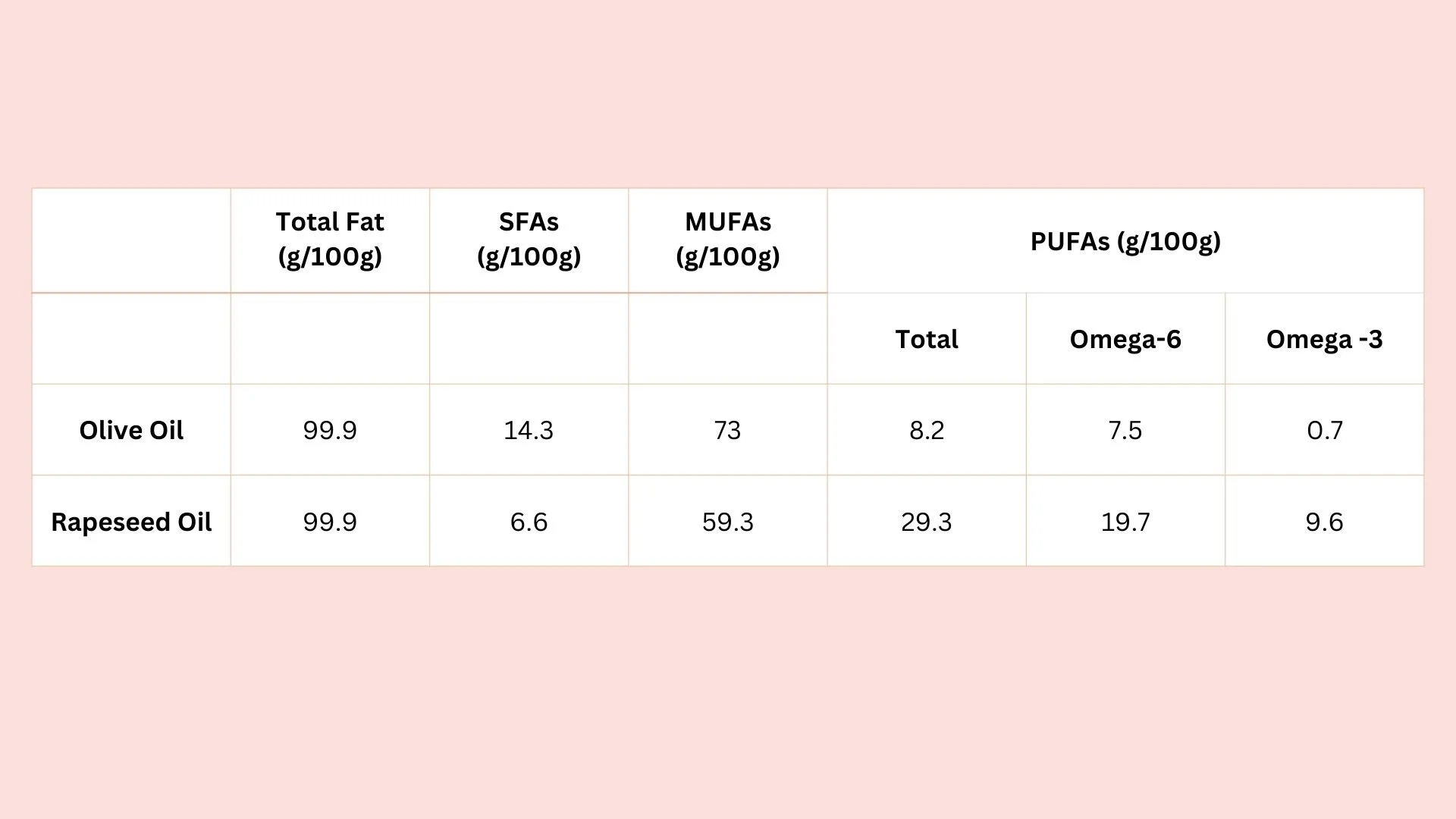
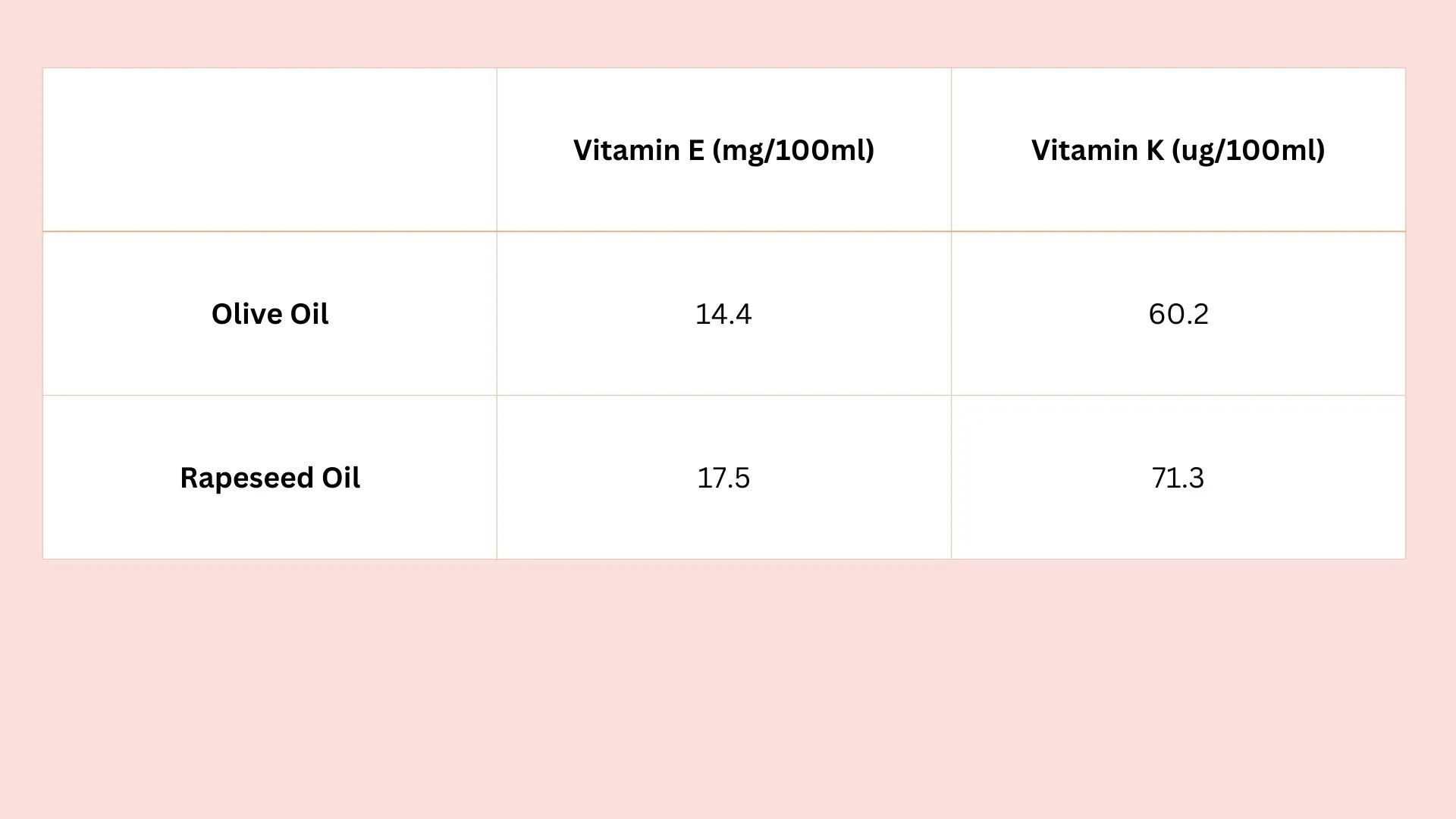
The higher MUFA content in olive oil makes it more resistant to oxidation, enhances antioxidant properties, stability and shelf life of other oils richer in PUFA. In terms of key micronutrients RO provides over 20% more vitamin E and over 18% more vitamin K per 100ml than olive oil. That’s not to say you would rely on oils to meet the recommended intakes for these vitamins, but they work in combination of food sources.
Scientific Evidence supporting another option
It’s hard to discount the weight and volume of scientific evidence supporting olive oil as the optimal choice as a cooking fat, with a heavy association as part of the Mediterranean Diet pattern. I use the word ‘pattern’ to stress the importance, although this diet has its roots in olive tree-growing countries of the Mediterranean, it’s the characteristics of a high consumption of vegetables, fruit, legumes, unprocessed cereals; with low intake of meats and dairy products; moderate consumption of fish; along with a high intake of unsaturated fats such as olive oil.
Matching this dietary pattern may be a stretch due to our northerly hemisphere location, thus as we are geographically closer we should align to the Nordic Diet pattern. This dietary pattern uses RO as its main cooking fat, allowing 15g per day, while the Med Diet recommends 20g of EVOO daily.
Unfortunately there is just not enough studies on RO in combination with the Nordic Diet but some studies comparing both diets found the Nordic Diet is as beneficial as Med Diet for reducing chronic diseases, disability, and mortality.
It is also important to be mindful of what we eat—not only to safeguard our health but also support the umbrella term of food sustainability that protects people, planet and animals. Our climate is more favourable to growing rapeseed than olives, so why not protect that integrity and secure a future in purchasing local in Ireland or the UK. Food sustainability is embedded in both the Med Diet and Nordic Diet with similarities of eating seasonally and buying local.
Heat is a limiting factor
As I mentioned earlier, exposure to heat can negatively impact the delicate polyphenol compounds found in EVOO. Similarly, subjecting any culinary oils to excessive or repeated heating has been shown to significantly reduce beneficial PUFA, while simultaneously increasing levels of trans fats and saturated fats, both of which are associated with adverse health effects. Certain culinary oils are often recommended for their higher smoke points; however, it is advisable to follow recommendations to maintain cooking temperatures below 200 °C and to avoid prolonged or repeated use in order to minimise the formation of health harmful compounds.
Processing
The limited processing that EVOO to goes through – put simply the raw juice is bottled – helps maintain the antioxidant and polyphenol compounds. This is not necessarily the case with RO, as the raw product requires greater intervention to extrapolate the oil. Various processes include solvent extraction and deodorisation to seek as much oil from the raw ingredient as possible. This can be visibly seen comparing different ROs in terms of its colour. The ‘cold-pressed’ RO has a darker honeyed colour in comparison to lighter coloured cheaper options. Despite this, the greater processing does not drastically impact the fatty acid profile but does reduce those fragile antioxidant compounds.
Concluding thoughts
If your primary goal is to obtain the health benefits attributed to polyphenols, do some research on your next EVOO purchase, with a price point to match the health promotion compounds. From my research, supermarket EVOOs are 60% more expensive than ROs with a similar fatty acid profile and as I mentioned they may not have the polyphenol compounds you may expect.
For those reasons I purchase a locally sourced ‘cold-pressed’ RO as my everyday cooking fat, which matches my pocket and my aspirations for a healthy diet. And honestly, I prefer the taste and the look of the darker honeyed colour, than that of more-refined RO options. Alongside that I sparingly use a premium EVOO that is rich in polyphenols with a bitter taste to match and that has independently tested statement.
